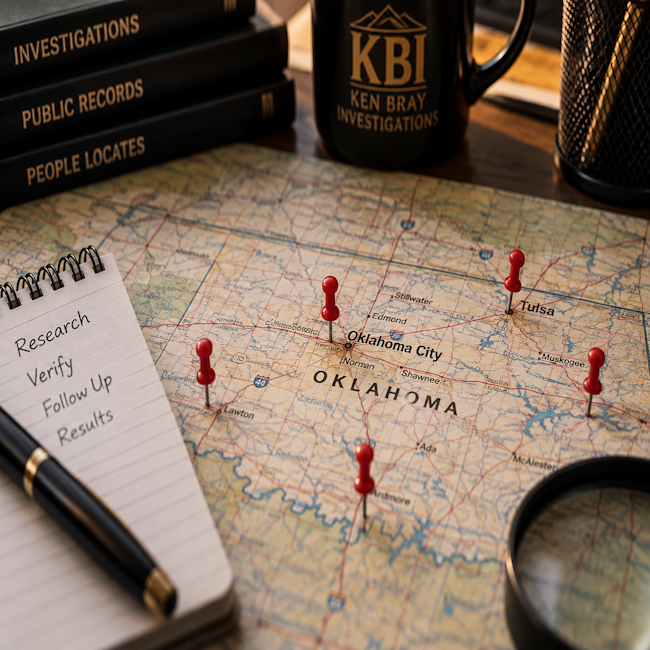
RESEARCH • VERIFICATION • PERSISTENCE
Professional Locate InvestigationsThroughout Oklahoma
Professional investigative research to help locate individuals when addresses, contact information, or other identifying details are incomplete, outdated, or unknown.
OKLAHOMA BUG SWEEPS & TSCM
More Than Looking for a Hidden Microphone
Concerns about electronic surveillance can involve more than a traditional hidden microphone or “bug.” Modern devices may be small, concealed, wireless, network-connected, or incorporated into ordinary objects, making a visual inspection alone insufficient.
Technical Surveillance Countermeasures (TSCM) is the professional process of examining an environment for potential unauthorized surveillance, listening, recording, or monitoring devices and related indicators. A bug sweep may involve a combination of physical inspection, electronic detection equipment, signal analysis, and other appropriate methods based on the environment and circumstances.
I approach each sweep methodically and objectively. The purpose is not to confirm a suspicion simply because a client believes surveillance is occurring. My responsibility is to examine the environment, evaluate what is detected or observed, and report the findings accurately.
WHAT YOU CAN EXPECT
- DISCREET SERVICE
TSCM concerns can involve sensitive personal or business circumstances, and the inspection is handled professionally and discreetly.
- SYSTEMATIC INSPECTION
The environment is examined using appropriate physical and electronic inspection methods rather than relying on a single device or detection technique.
- OBJECTIVE EVALUATION
Unusual signals, devices, wiring, or other findings are evaluated before conclusions are reached.
- CLEAR COMMUNICATION
I will explain relevant findings and discuss any concerns identified during the inspection.
PHYSICAL • ELECTRONIC • WIRELESS
Looking Beyond What You Can See
Unauthorized surveillance can take different forms, and the appropriate inspection depends on the environment and the concerns involved. A professional bug sweep considers both the physical space and the electronic environment rather than focusing on one particular type of device.
Depending on the circumstances, the inspection may include areas, equipment, signals, and objects that could potentially be associated with unauthorized listening, recording, monitoring, or surveillance.
PHYSICAL ENVIRONMENT
-
Rooms & Workspaces
Offices, residences, meeting areas, and other spaces can be examined for unusual devices, modifications, wiring, or other indicators that warrant closer evaluation.
-
Common Objects & Furnishings
Everyday objects and furnishings may be examined when their location, condition, or characteristics raise legitimate concerns.
-
Electrical & Connected Equipment
Relevant electrical, communications, and connected equipment may be evaluated as part of the inspection.
-
Vehicles
When appropriate to the case, vehicles may also be examined for potential unauthorized surveillance or monitoring equipment.
ELECTRONIC ENVIRONMENT
-
Radio Frequency Activity
Wireless activity within the environment may be evaluated to identify signals or transmissions that warrant additional investigation.
-
Listening & Recording Devices
The inspection may address concerns involving concealed microphones, recorders, transmitters, or similar equipment.
-
Video Surveillance Devices
Potential concealed cameras or other unauthorized video-monitoring equipment may be considered during the inspection.
-
Other Electronic Concerns
Technology changes quickly, and not every surveillance concern fits a single category. The inspection approach can be adjusted based on the environment and information developed during the case.
No single piece of equipment can identify every possible surveillance threat. A professional TSCM inspection relies on multiple methods, careful evaluation, and investigative judgment.
WHEN PRIVACY IS A CONCERN
Situations That May Warrant a
Bug Sweep Inspection
A bug sweep may be appropriate when there is a reasonable concern that private conversations, activities, or information could be monitored without authorization. Sometimes the concern follows a specific event or discovery. In other cases, confidential information appears to be reaching someone who should not have access to it.
A concern does not automatically mean that electronic surveillance is occurring. A professional inspection can help evaluate the environment objectively rather than beginning with that assumption.
DOMESTIC & PERSONAL CONCERNS
Relationship disputes, separation, stalking, harassment, or other personal circumstances have created legitimate concerns about unauthorized monitoring.
AFTER ACCESS BY AN UNAUTHORIZED PERSON
Someone with questionable or unauthorized access has entered a residence, office, vehicle, or other private area where sensitive information may be discussed or stored.
PRECAUTIONARY INSPECTIONS
Some clients may have a legitimate need to evaluate a sensitive environment even when no specific device has been discovered or confirmed.
CONFIDENTIAL INFORMATION IS BEING DISCLOSED
Private conversations, plans, or information appear to be known by someone who should not reasonably have access to them.
SUSPICIOUS OR UNFAMILIAR DEVICES
An unfamiliar device, wiring change, electronic component, or other object has been discovered and its purpose is unclear.
BUSINESS & PROFESSIONAL PRIVACY
Offices, conference rooms, executive spaces, or other areas are used for sensitive conversations, negotiations, legal matters, or confidential business information.
Finding something unusual does not necessarily mean it is a surveillance device. Modern homes, offices, and vehicles contain numerous legitimate electronic and wireless devices. Suspicious findings should be evaluated before conclusions are reached.
LOCATE SERVICES FOR A VARIETY OF CASES
Locating People for Legitimate Investigative Needs
There are many legitimate reasons someone may need to be located. Attorneys may need a current address for a party, witness, or other individual connected to a legal matter. Businesses may need to locate someone associated with an unresolved issue. Individuals may be searching for a family member or another person for a legitimate personal reason.
Before accepting a locate case, I consider the purpose of the search and the information available. I do not provide locate services when the circumstances raise concerns about harassment, stalking, intimidation, or another improper purpose.
LEGAL & PROFESSIONAL LOCATES
-
Parties to Legal Matters
Locating individuals connected to pending or anticipated legal proceedings.
-
Witnesses
Research to help identify current information for witnesses or other individuals who may have information relevant to a case.
-
Process Service Locates
Developing current address information when an individual needs to be served but the address provided is outdated, incomplete, or no longer valid.
-
Business-Related Locates
Developing current address information when an individual needs to be served but the address provided is outdated, incomplete, or no longer valid.
PERSONAL & FAMILY LOCATES
-
Family Members
Assistance locating relatives when current contact or address information is no longer available.
-
Former Friends & Associates
Research to help locate someone with whom legitimate contact has been lost over time.
-
Address & Contact Verification
Research to help determine whether existing information for an individual is current and connected to the correct person.
-
Other Legitimate Locate Needs
Situations do not always fit neatly into a category. I can review the circumstances and determine whether there is an appropriate investigative approach.
Locate services are provided only for legitimate purposes. I reserve the right to decline a locate request when the circumstances or intended use of the information raise legal, safety, privacy, or ethical concerns.
CURRENT INFORMATION MATTERS
Finding an Address Is Not the Same as Finding the Person
Locate research may produce an address associated with the person being sought, but that does not necessarily mean the individual currently lives or can be found there. Records can lag behind real-world changes, and an address may belong to a relative, former residence, previous employer, or another connection.
When the objectives of the case require greater certainty, additional investigative work may be appropriate to help determine whether the information developed is current and actually connected to the individual being located.
The level of verification needed depends on the purpose of the locate. My goal is to provide information that is useful for the case rather than simply return the first address that appears in a search.
CURRENT VS. HISTORICAL
Address history can help distinguish a current lead from information that may no longer be useful.
ADDRESS VERIFICATION
When appropriate, additional investigative steps may be used to help determine whether an individual is currently associated with a particular location.
IDENTITY CONFIRMATION
Names, dates, relationships, locations, and other identifying information can help distinguish the correct individual from people with similar information.
CASE-APPROPRIATE RESULTS
The amount of verification performed depends on the objectives of the case and how the information will be used.

PROFESSIONAL LOCATE SERVICES
Locate Investigations for a Variety of Clients
The reason someone needs to be located can vary considerably from one case to another. I provide locate services for attorneys, businesses, individuals, and other professionals when there is a legitimate reason to develop current information about a person.
Every locate request is evaluated individually. I consider the purpose of the search, the information available, and how the information developed may be used before accepting a case.
ATTORNEYS & LAW FIRMS
Locate research for parties, witnesses, defendants, heirs, and other individuals connected to litigation or other legal matters.
OTHER PROFESSIONALS
Investigative locate assistance for process servers, investigators, legal professionals, and others who need reliable information in connection with a legitimate case or professional purpose.
BUSINESSES & ORGANIZATIONS
Assistance locating individuals connected to legitimate business, administrative, financial, or other professional matters.
INDIVIDUALS
Locate investigations involving family members, former friends or associates, and other legitimate personal circumstances where current information is no longer available.
FROM INITIAL CONTACT TO CASE ACCEPTANCE
Starting a Locate Investigation
Every locate begins with understanding who you are trying to find, why you need to locate them, and what information is already available. The more accurate starting information you can provide, the better I can evaluate the case and determine an appropriate investigative approach.
01 — Complimentary Initial Consultation
We will begin with a brief complimentary consultation of up to 15 minutes. This allows me to understand the general circumstances, the reason for the locate, and whether I may be able to assist.
02 — Submit Your Case Information
If the locate appears appropriate, I will ask you to provide the information you have about the individual. Names, previous addresses, telephone numbers, dates of birth, relatives, employers, photographs, and other identifying details may help establish useful starting points.
03 — Case Review & Consultation
I will review the information provided and evaluate the circumstances, available starting information, and investigative objectives. When appropriate, we will discuss the potential scope of the locate and any additional information that may be needed.
04 — Case Acceptance
If I accept the case, we will address the necessary agreements, authorization, scope, and other requirements before investigative work begins.
RESEARCH • VERIFICATION • RESULTS
Useful Information Developed Through Investigation
The objective of a locate investigation is to develop the most reliable and useful information reasonably available about the person being sought. What is developed will depend on the starting information, the circumstances of the individual, and the investigative methods appropriate to the case.
Some investigations may identify and verify a current location. Others may develop updated contact information, address history, associates, or other information that provides a meaningful lead for additional investigation.
I will report what the investigation establishes and distinguish verified information from information that may require additional investigation. I will not represent an address or other information as current simply because it appears in a database or record.
The outcome of every locate is different. A locate investigation cannot guarantee that an individual will be found or that a current address will be developed.
What You Receive
- CURRENT INFORMATION
Current or recently developed address, contact, or other relevant information when it can be reasonably established through the investigation.
- SUPPORTING INFORMATION
Relevant address history, relationships, associations, or other information that helps connect the individual to the information developed.
- INFORMATION VERIFICATION
Available information is compared and evaluated to help distinguish reliable findings from outdated records or uncertain leads.
- INVESTIGATIVE REPORTING
You will receive appropriate reporting or documentation describing the investigative work performed and the information developed.
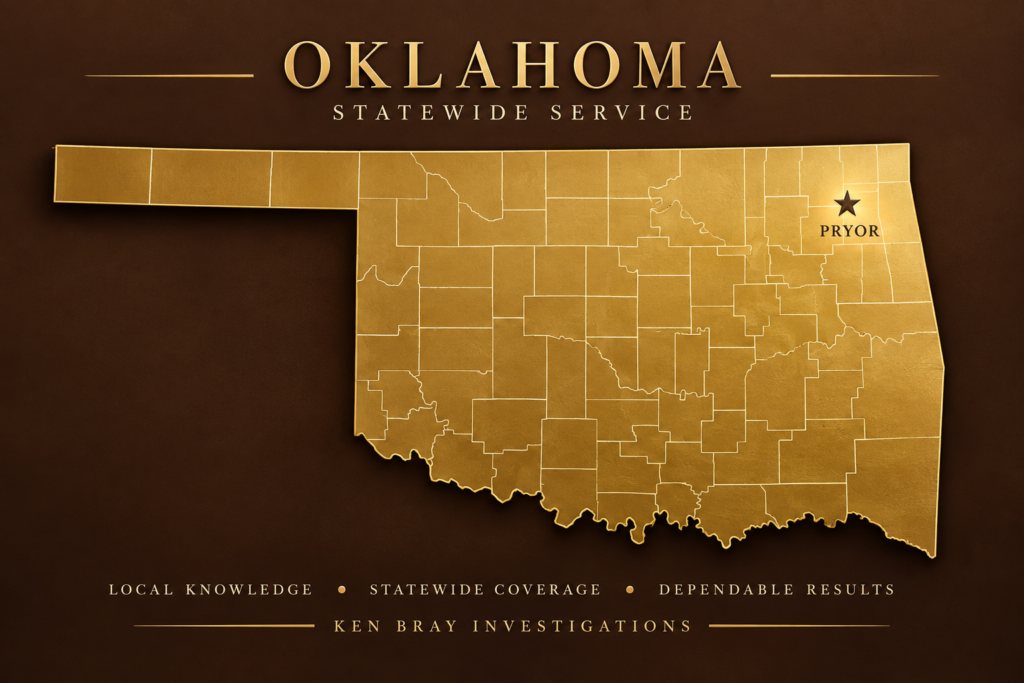
LOCATE INVESTIGATIONS THROUGHOUT OKLAHOMA
Professional Locate Services Across Oklahoma
I provide professional locate investigations throughout Oklahoma for attorneys, businesses, individuals, and other professionals who have a legitimate need to locate someone or develop current information about an individual.
The person being sought does not necessarily need to be located in the same area as the client. Locate investigations often begin with information connected to different cities or counties, and the research may lead beyond the location where the case originated.
Each case is evaluated based on the information available, the purpose of the locate, and the investigative work that may be required.
FREQUENTLY ASKED QUESTIONS
Locate Investigation FAQs
1. What information do you need to begin a locate investigation?
Any accurate information you already have can be helpful. This may include the person’s full name, previous addresses, telephone numbers, date of birth, relatives, employers, photographs, vehicles, email addresses, or other identifying information. You do not need to have all of these. I will evaluate what is available and determine whether there is enough information to begin.
Can you find someone with only a name?
Possibly, but it depends on the circumstances. A common name with no additional identifying information can make it difficult to distinguish the correct person from others with the same or similar name. Even a small amount of additional information may help narrow the search and establish useful connections.
Can you guarantee that you will find the person?
No. No locate investigation can guarantee that an individual will be found. The amount and accuracy of the starting information, how recently the person’s information has changed, and other circumstances can affect the outcome. I will explain what the investigation establishes without representing uncertain information as a confirmed result.
Is an address from a database considered a confirmed location?
Not necessarily. Database information and public records can be outdated or may reflect a previous residence, relative’s address, mailing address, or another connection. When the purpose of the case requires greater certainty, additional research or investigative steps may be appropriate to help verify the information.
Can you locate someone so legal documents can be served?
Yes. Locate research can be useful when an individual needs to be served but the address provided is outdated, incomplete, or no longer valid. When appropriate, locate services can also be coordinated with my process service work.
Can you locate a family member or someone I have lost contact with?
Potentially. I can review requests involving family members, former friends, associates, and other individuals when there is a legitimate reason for the search. I evaluate the circumstances before accepting the case and may decline a request when the intended purpose raises legal, privacy, safety, or ethical concerns.
Will you give me someone’s address once you find them?
That depends on the circumstances and the legitimate purpose of the investigation. Locating an individual does not automatically mean that every piece of information developed will be appropriate to disclose. I consider the nature of the case, the intended use of the information, and any applicable legal, safety, privacy, or professional considerations.
Do you provide locate investigations throughout Oklahoma?
Yes. I provide locate investigations throughout Oklahoma. Each request is evaluated individually based on the person being sought, the information available, the purpose of the locate, and the investigative work that may be required.
NEED HELP LOCATING SOMEONE?
Start With a Confidential Conversation
If you need to locate someone for a legitimate legal, professional, or personal reason, start with a brief complimentary consultation. I will listen to the circumstances, review the information you currently have, and determine whether a locate investigation may be appropriate for your situation.